How Can Bluetooth Modules Achieve One-to-Many Communication?
This is a classic Bluetooth application question. Bluetooth modules primarily achieve one-to-many communication through the following two core methods, which are suited for different scenarios and Bluetooth versions.

Core Concept: Master-Slave Model
First, understand the basic roles in Bluetooth communication:
Master Device: Acts like a "router" or "host." It initiates connections, searches for and connects to slave devices, and manages the connection timing. The "one" in one-to-many is the master device.
Slave Device: Acts like a "connected device." It can only wait to be connected and respond to requests from the master. The "many" in one-to-many are the slave devices.
A single Bluetooth master device can communicate with multiple slave devices simultaneously.

Method 1: Piconet (Scatternet Foundation)
This is the most direct and commonly used method for "one-to-many."
How it works: A single master device establishes independent, point-to-point connections with multiple slave devices. The master device time-division multiplexes between its connections-rapidly taking turns communicating with each slave.
Number of Connections: Theoretically, a standard master can connect to up to 7 slave devices (with certain chips and configurations, this number can be 20 or even higher, but practical performance may degrade).
Communication Characteristics:
Bidirectional & Reliable: The master can actively send data to any slave and also receive data from them.
Connection-Oriented: Requires a pairing/connection process first to establish a stable link.
Master-Controlled: All communication is scheduled by the master; slave devices cannot communicate directly with each other.
Bluetooth Versions: Supported by both Classic Bluetooth and Bluetooth Low Energy (BLE).
Typical Application Scenarios:
POS Terminal/Card Reader: One master POS terminal connected to multiple Bluetooth scanners.
Central Data Collector: One master device connected to multiple distributed sensors (temperature, humidity, pressure, etc.).
Computer Peripherals: One computer simultaneously connected to a Bluetooth keyboard, mouse, and headset.

Method 2: Broadcasting
This method is ideal for one-to-many, one-way data distribution scenarios.
How it works: One device acts as a "Broadcaster". It does not establish any connections but periodically "shouts" its data packets to the surroundings. Any devices set to "Observer" mode can passively "listen" to these broadcast packets.
Communication Characteristics:
Unidirectional & Unreliable: Data flows from the broadcaster to the observer(s), with no acknowledgment mechanism, so packets can be lost.
Connectionless: No pairing or connection setup is needed, resulting in very low latency.
True "One-to-Many": Theoretically, broadcast data can be received by an unlimited number of observers.
Low Power Consumption: Observers do not need to establish or maintain connections, allowing for very low power consumption.
Bluetooth Versions: Primarily a core feature of Bluetooth Low Energy (BLE).
Typical Application Scenarios:
Beacons: e.g., product promotions in malls, indoor navigation.
Wireless Broadcasts: e.g., distributing scoreboard information in a stadium.
Sensor Data Broadcast: A temperature sensor broadcasts its readings, and multiple phones or gateways can receive them simultaneously.
Item Finders/Trackers: The tracker broadcasts a signal, and a phone acts as an observer to receive it and judge the signal strength.
Advanced Method: Bluetooth Mesh Networking
This is a more powerful "many-to-many" solution designed for large-scale device networks, but it also perfectly achieves "one-to-many" control.
How it works: It's built upon the BLE broadcasting mechanism. All devices (nodes) in the network are no longer in a simple master-slave relationship. A message sent by one device can be received and forwarded by other devices (relay nodes) in the network until it reaches the target device. This allows messages to travel much farther, like a "relay race."
How it achieves "One-to-Many": You can configure one device (e.g., a phone) as a "Provisioner" and "Client" to send a command (e.g., "Turn On Lights") onto the network. All "Server" nodes (e.g., multiple lights) configured to subscribe to that command will execute the action simultaneously.
Communication Characteristics:
High Reliability: Overcomes the range limitations of a single device by relaying messages.
Large-Scale Networks: Can support hundreds or thousands of nodes.
Complex Setup: Requires a dedicated Mesh protocol stack and provisioning process.
Typical Application Scenarios:
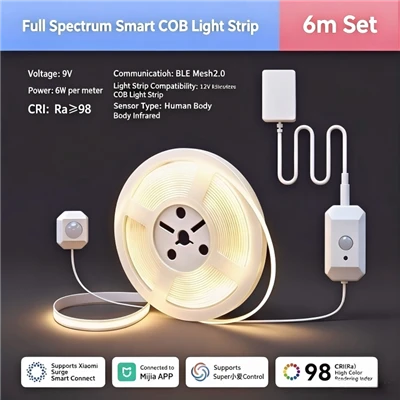
Smart Lighting: One switch controlling all lights in an entire room simultaneously.
Building Automation: Sensor networks, security systems.
Industrial IoT (IIoT): Large-scale sensor and control networks.
Summary and Selection Guide
| Feature | Piconet | Broadcasting | Bluetooth Mesh |
|---|---|---|---|
| Direction | Bidirectional | Unidirectional (Broadcaster -> Observer) | Bidirectional/Multidirectional |
| Connection | Connection Required | Connectionless | Network Membership Required |
| Reliability | High (with Acknowledgment) | Low (No Acknowledgment) | High (Multi-Path Relay) |
| Slave Count | Limited (Typically < 20) | Theoretically Unlimited | Large Scale (1000s) |
| Power Use | Medium | Very Low (Especially for Observer) | Depends on Node Role |
| Latency | Relatively Low | Very Low | Depends on Network Hops |
| Typical Use | Data Collection, Peripherals | Beacons, Information Dissemination | Smart Home, Industrial Control |
How to Choose?
Do you need bidirectional, reliable communication with a few to a few dozen devices? -> Choose Piconet.
Do you only need to send data one-way, quickly to countless devices and don't care about acknowledgment? -> Choose Broadcasting.
Do you need to control hundreds or thousands of devices reliably over a large area? -> Choose Bluetooth Mesh.