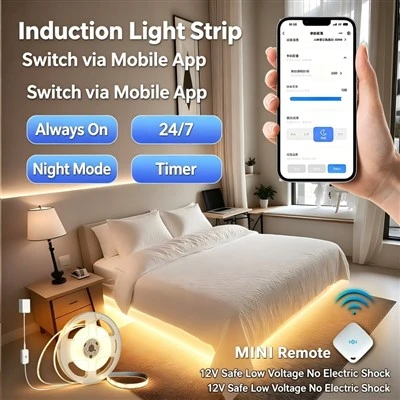
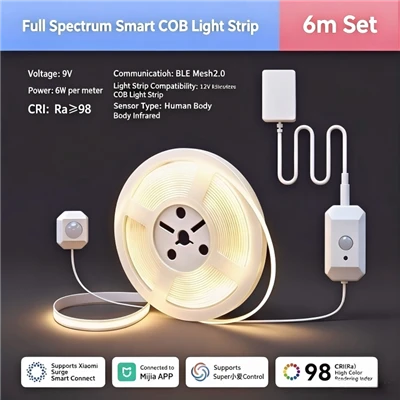
The answer is: Choose a Bluetooth module that supports the Bluetooth Mesh protocol, preferably Bluetooth 5.0 or higher. This is currently the most mature and suitable solution.

Below, I'll break down why it's the best choice, how to implement it, and the key considerations.
1. Why is Bluetooth Mesh the Best Choice?
Self-Forming & Multi-to-Multi Communication: Traditional Bluetooth uses "one-to-one" or "one-to-few" (star topology), while Mesh networks are "many-to-many." Each light bulb (node) can act as a relay, forwarding signals from other nodes to form a network.
Massive Scalability: A single Bluetooth Mesh network can theoretically support over 32,000 nodes, easily meeting your needs for hundreds of bulbs.
Extended Coverage: Signals hop between nodes, easily penetrating walls and covering your three-floor space. With proper node distribution, the network can extend almost indefinitely.
High Reliability: The network features "self-healing." If a node fails or a path is blocked, messages automatically reroute through alternative paths, preventing system failure.
Standardization & Ecosystem: Bluetooth Mesh is an official standard from the Bluetooth Special Interest Group (SIG) with robust specifications. It's natively supported by platforms like Apple HomeKit and Xiaomi's smart home ecosystem, making future integration easier.

2. Specific Implementation Steps
Step 1: Select the Right Bluetooth Mesh Module (Procurement Focus)
Recommended search keywords:
Chipset-Oriented: Bluetooth Mesh module nRF52840, Bluetooth Mesh module TLSR825x, Bluetooth Mesh module Silicon Labs EFR32BG22.
Nordic nRF52 Series: Industry benchmark, stable performance, richest development resources and community, relatively higher cost.
Telink TLSR8/9 Series: Extremely high market share in smart lighting, mature solutions, cost-effective, used by many major brands.
Silicon Labs EFR32 Series: Excellent RF performance, professional development tools.
Application-Oriented: Smart lighting Bluetooth Mesh module, Light bulb Bluetooth Mesh solution.
Key Procurement Checklist:
✅ Must support the Bluetooth Mesh protocol stack (ask the supplier if it's integrated and validated).
✅ Recommended Bluetooth version 5.0 or higher (Mesh officially supported from 5.0, with better performance).
✅ Choose an external antenna or high-performance PCB antenna version to ensure per-node coverage.
✅ Confirm the module is BQB certified, including Mesh subsystem certification.
✅ Evaluate power consumption: Bulbs have mains power, so consumption isn't the top priority, but low-power chips reduce heat.
✅ GPIO and PWM capability: Can it directly drive or control LED dimming/color tuning? Check the module's interfaces.
Step 2: Network Architecture Design
Node Types:
Relay Nodes: Most bulbs in the network should be set as relay nodes, responsible for forwarding messages to extend the network. This slightly increases power consumption but is negligible for mains-powered devices.
Low-Power Nodes: Special nodes (like battery-powered switches/sensors) can be set as low-power nodes-they only send/receive their own messages and don't relay, saving power.
Provisioner: A device is needed to "enroll" bulbs into the network. This is typically a smartphone App (you'll need to develop or use a generic Mesh provisioning App) or a gateway device. During initial setup, use the phone to scan each bulb's QR code for network configuration.
Step 3: Control Logic Implementation
Group & Scene Control: This is Mesh's biggest advantage. Assign all bulbs or bulbs on each floor to one or more "Group Addresses." Send a command to a group address, and all bulbs in the group respond simultaneously, enabling one-touch all-on/all-off or scene modes (movie, party).
Switching & Dimming: Control via smartphone App, Bluetooth Mesh wall switches (also Mesh nodes), or a gateway.
Step 4: External Network Connectivity (Optional but Recommended)
Why a Gateway? A pure Bluetooth Mesh network requires a phone within Bluetooth range for direct control. To enable remote control (turning off home lights from the office), voice control (via Xiao Ai, Tmall Genie), or scheduling, a Bluetooth Mesh gateway is needed.
Gateway Role: It acts as both a node in the Mesh network and connects to the internet/home LAN via Wi-Fi or Ethernet, bridging the Bluetooth Mesh network with the outside world.
Options: Purchase off-the-shelf gateways or develop a simple gateway using modules with integrated Wi-Fi (like ESP32).
3. Key Challenges & Considerations
Network Configuration Complexity: Initially enrolling hundreds of devices (provisioning) is labor-intensive. Plan the installation and provisioning process carefully. Choose a module supplier that supports "batch provisioning" or "one-touch provisioning" to greatly improve efficiency.
Signal Interference: The 2.4GHz band is crowded (Wi-Fi, microwaves). Bluetooth Mesh uses frequency hopping and message retransmission to mitigate interference, but avoid placing many devices directly next to Wi-Fi routers.
Latency: Messages experience slight delays when relayed multiple hops. For lighting control, this latency (typically <100ms) is hardly noticeable. Ensure sufficient node density to avoid too many hops in a single path.
Supplier Selection: Don't just buy modules; buy a "solution." Prioritize suppliers offering:
Complete Mesh SDK and lighting application layer sample code (e.g., dimming, color temperature control).
Smartphone App provisioning Demo.
Hardware reference designs optimized for lighting (schematics, PCB layout).
Professional technical support to assist with network debugging.
Summary & Action Roadmap
Clarify Requirements: Decide if remote/voice control is needed. If yes, plan for a gateway.
Find Solution Providers: Search for "smart lighting Bluetooth Mesh complete solution," contact 3–5 module/solution suppliers, and request their "lighting Mesh development kit."
Evaluate & Test: Use the development kit to build a small network of 20–30 nodes for real-world testing:
Is the provisioning process smooth?
How responsive is group control?
What's the success rate of controlling bulbs in different locations (stairs, corners)?
How is the smartphone App experience?
Small-Batch Trial Production: After testing, proceed with a small production run (e.g., 100–200 units) for final validation in real installation environments.
Large-Scale Deployment: Refine installation guidelines (e.g., node density), then proceed with full-scale deployment.
In a nutshell: For a "hundreds of bulbs, three-floor coverage" lighting control project, a Bluetooth Mesh module solution based on mature chipsets (like Telink TLSR series or Nordic) is the most technically suitable, cost-effective, and future-ready choice. The key to success lies in partnering deeply with a supplier experienced in the lighting industry.