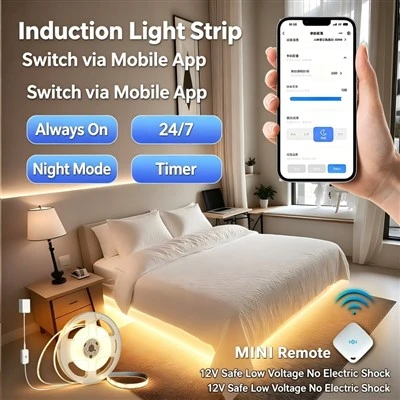
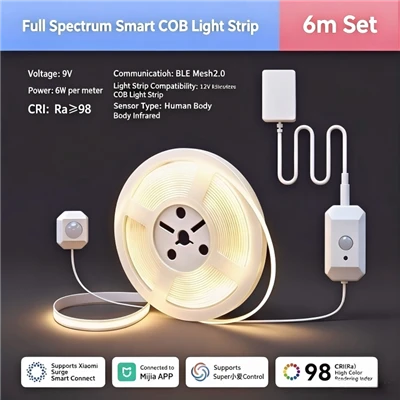
COB (Chip on Board) strip lights are a new type of LED strip utilizing high-density chip packaging technology, and they are highly popular in the lighting market. Overall, their main advantages and disadvantages are as follows:

Main Advantages
1. Dot-Free and Uniform Lighting
This is the core advantage of COB strip lights. Because the LED chips are densely integrated directly onto the substrate and covered with a layer of phosphor glue, the light is refracted and reflected to form a continuous, soft linear light band. It completely eliminates the "dotty" granularity of traditional SMD strip lights, making it perfect for minimalist designs that require "seeing the light, not the fixture."
2. High CRI and Color Rendering
COB strip lights typically offer an exceptionally high Color Rendering Index (CRI > 90 or even higher), which can reproduce the true, natural colors of objects. They are highly suitable for scenes with strict color requirements, such as commercial displays, kitchen prep areas, and inside wardrobes.
3. Better Heat Dissipation and Longer Lifespan
High-quality COB strip lights mount the chips directly onto metal substrates, resulting in a shorter heat transfer path and lower thermal resistance. This design helps dissipate heat quickly, reducing light decay and extending the lifespan (high-quality products can last over 50,000 hours).
4. Wide Beam Angle
The light-emitting surface of COB strip lights usually achieves a wide 180-degree beam angle, providing a more uniform light distribution and a broader illumination range.
5. Flexible Installation and Cutting
Some COB strip lights support "cut-per-LED" or millimeter-level free cutting. This allows for flexible length customization during installation, adapting to various narrow or irregularly shaped spaces.
Main Disadvantages
1. Relatively Higher Price
Due to the complex COB packaging process and the high requirements for substrate materials (such as thick copper foil) and phosphors, COB strip lights are generally 20% to 50% more expensive than standard SMD strip lights of the same specifications.
2. Light Efficacy and Brightness Loss
Although COB strip lights are bright enough, the surface layer of mixing glue slightly weakens the light as it passes through. Therefore, when compared at the same price point, their absolute luminous efficacy (lm/W) and brightness are often lower than traditional SMD strip lights with exposed LEDs.
3. Voltage Drop Over Long Distances (Dimming at the End)
Because of the dense chips and high current, COB strip lights experience relatively fast voltage loss. Continuous installations exceeding 10 meters often show a noticeable voltage drop (i.e., the end of the strip becomes significantly dimmer). This usually requires adding extra power supply lines in the middle, which increases wiring complexity.
4. Strict Heat Dissipation and Installation Requirements
High integration means concentrated heat. If the heat dissipation design is poor (e.g., not used with aluminum profiles), long-term operation can cause severe heating, accelerating light decay or even damaging the strip. Additionally, the soft silicone material on the surface of COB strip lights easily attracts dust and is hard to clean. Repeated peeling and sticking during installation can also damage the micro-chips.
5. Difficulty in Batch Color Consistency
Due to the nature of the COB process, controlling color consistency across different production batches is more challenging than with traditional LEDs. Large-scale engineering projects may need to pay special attention to color tolerance.